
Tide Basics for Beginners: Heights, Streams, and Diamond Data
Tide is the invisible current that makes skippers look brilliant—or busy. Learn how to get height right for clearance, how to read streams and tide diamonds for set/drift, and how to combine both into a calm, predictable plan.
Two different “tides”: height vs stream
- Tidal height answers “How much water is under me (or under that drying patch) at a given time?” You’ll use tide tables, heights at high/low water, and curves/rule of twelfths.
- Tidal stream answers “Which way—and how fast—is the sea moving past the seabed?” You’ll use tide diamonds and stream atlases (set in degrees, rate in knots) keyed to a standard port’s HW time.
Heights: quick method for planning clearance
For a first-pass estimate, the rule of twelfths splits the vertical tidal range (HW–LW) over the six hours between HW and LW into 1–2–3–3–2–1 twelfths. It’s a simplification, but good enough for many coastal plans. For accuracy, use the tidal curve in your almanac or app.
Worked example — height at a specific time
Scenario: You need depth over a bar at 15:00. The tide table (standard port) shows HW 11:30 4.6 m and LW 17:30 0.8 m. Your charted depth over the shallowest patch is 1.0 m above CD. Your yacht draws 1.7 m. Is it deep enough at 15:00?
- Range: 4.6 − 0.8 = 3.8 m.
- Time since HW: 15:00 − 11:30 = 3.5 h.
- Fall by rule of twelfths: first 3 hours = (1 + 2 + 3)/12 = 6/12 = 0.5 of range = 0.5 × 3.8 = 1.9 m. Half of the 4th hour = 0.5 × (3/12) = 1.5/12 of range = (1.5/12) × 3.8 = 0.475 m. Total fall = 1.9 + 0.475 = 2.375 m.
- Height at 15:00: HW 4.6 − 2.375 = 2.23 m (approx).
- Under-keel clearance: Charted depth 1.0 + tide 2.23 = 3.23 m water. 3.23 − draft 1.7 = 1.53 m UKC (before wave, heel and squat allowances). Safe with margin.
For drying heights, approach the same way but remember a drying height (e.g., 0.6 m) means the seabed stands above CD by that amount at LW. You add the tide to see how much covers the top of the bar at your time.
Handy worksheets
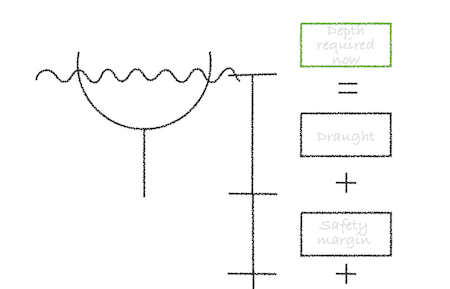
Height of tide needed to clear a drying height
Height of tide needed to clear a charted depth
Secondary ports: adjusting from the standard
If your harbour isn’t a standard port, the almanac provides time and height differences to apply to the nearest standard port. Adjust HW/LW times first, then heights, then run your curve/twelfths as normal. Stick the adjustment table in your passage plan so your crew can double-check.
Streams: using tide diamonds and atlases
- Find the nearest diamond to your leg (A, B, C…).
- Look up the table using “hours before/after HW” at the standard port. Note the set (direction) and rate (knots) for your time window.
- Plot a tidal vector from your DR position: draw an arrow in the set direction with length equal to the rate × time (e.g., 2.3 nm for 2.3 kn in one hour).
- Add your boat vector (speed through the water along your intended heading). The sum gives your ground track.
- Tweak the heading until the ground track runs where you want. That heading is your course to steer (CTS).
Don’t like triangles? You can iterate: steer a little up-tide of the desired track and check cross-track error (XTE) every few minutes, adjusting until XTE holds near zero.
Streams meet heights: real-world timing
Height tells you if there’s water; streams tell you how the boat will move. If your bar is safe only for two hours either side of HW and the stream runs hard across the entrance at HW+2, pick the earlier window when the set is kinder—even if the water is slightly shallower.
Common mistakes (and simple fixes)
- Using the wrong standard port: time offsets and stream phases shift by location. Triple-check the port name at the top of the table.
- Forgetting BST/UTC changes: make sure your tide table time zone matches your watch and plotter.
- Treating rule-of-twelfths as gospel: it’s a curve, not a staircase. Use it for estimates; use curves for precision.
- Ignoring wave/heel/squat in UKC: leave margin in onshore wind and shallow, fast water.
- Plotting the wrong hour in diamonds: always confirm “HW+N” or “HW−N” (and which port) before drawing vectors.
Build the habit
- Put “Heights OK?” and “Streams OK?” as two separate lines in your Passage Planning & Making checklist.
- Before every trip, skim Weather (Meteorology) and compare the Inshore Waters forecast with your plan for wind-against-tide risk.
Enrol when you’re ready
- Start Day Skipper Theory (online)
- Enrol in Essential Navigation & Seamanship (online)
- Join the free Sailing Essentials course
Related RYA courses (overview & providers)
Tide isn’t out to get you—it’s free speed if you plan for it. Check heights, read the diamonds, and give yourself margin. Your passages will feel smoother overnight.