
VHF Marine Radio License Guide: Get Your UK VHF Marine Radio License
When you’re out on the water, your VHF radio isn’t just a piece of kit—it’s your most important safety lifeline. It connects you to other vessels, shore stations, and, most critically, to emergency services when things go wrong.
But using one isn’t a free-for-all. To keep the airwaves clear and ensure everyone can communicate effectively, especially in a crisis, its use is strictly regulated. This isn’t about red tape; it’s about maintaining a reliable, universally understood communication network that saves lives.
Think of it like getting a driver’s licence. You need to prove you know the rules of the road before you get behind the wheel. The same logic applies here. In the UK, this means you can’t just buy a radio and start broadcasting. You need to be properly licensed.
The Two-Part UK Licensing System
Here in the UK, the system is straightforward and has two essential parts. You need a licence for the radio equipment itself, and a separate certificate for you, the person operating it. This ensures both the gear and the user meet the right standards.
Let’s take a look at what each one involves.
UK VHF Radio Licence Requirements at a Glance
This table breaks down the two key licences you’ll need to operate a VHF radio legally on a UK-flagged vessel.
| Licence Type | What It Covers | Who Needs It | Governing Body |
|---|---|---|---|
| Ship Radio Licence | The installation and use of radio equipment (including VHF, EPIRB, SART) on a specific vessel. | Anyone with a fixed or handheld VHF radio on a UK-registered boat. | Ofcom |
| Operator’s Certificate (SRC) | Your personal qualification, proving you know how to use the radio correctly. | Anyone operating a marine VHF radio. It’s a lifetime qualification. | RYA (on behalf of the MCA) |
Without both of these in place, you are legally not allowed to transmit on marine VHF frequencies. It’s a simple but non-negotiable requirement for responsible boating.
Getting Certified: The Operator’s Licence
The first part of the puzzle is the licence for the radio set itself. This is issued by Ofcom and comes in two main flavours: a Ship Radio Licence for radios fixed to a specific UK-flagged vessel, or a Ship Portable Radio Licence for handheld VHFs that you might move between boats.
The second, and arguably more important, part is your personal operator’s certificate. This proves you have the knowledge to use the radio properly. For most recreational sailors, this means getting the RYA Short Range Certificate (SRC).
Holding an SRC demonstrates that you understand:
- How to operate a modern DSC-equipped VHF radio.
- The correct voice procedures for distress, urgency, and safety calls.
- The proper etiquette for routine, day-to-day radio traffic.
This dual-licence system is the bedrock of maritime radio safety in UK waters. It’s designed to ensure that when you transmit, you do so clearly, correctly, and without interfering with others—especially in an emergency.
While these are the specific rules for the UK, it’s worth remembering they fit into a much bigger global picture of maritime safety. Authorities worldwide, like the ones setting the U.S. Coast Guard requirements for boaters, all put a huge emphasis on proper communication skills.
Getting your licence isn’t just a box-ticking exercise; it’s the first and most important step toward becoming a truly safe and responsible skipper.
The Ship Licence vs. The Operator Certificate: What’s the Difference?
One of the most common points of confusion for new boaters is the difference between licensing the boat and licensing the person using the radio. It’s a simple distinction once you get it, and a good analogy is a taxi. The car itself needs its own registration and licence plates, while the driver needs a separate driving licence to operate it.
Maritime radio rules work exactly the same way. The law separates the vessel’s equipment from the person at the helm. For safe and legal radio use in the UK, you absolutely need both parts of the puzzle in place. One is tied to your boat, and the other is your personal qualification.
Let’s break down what each one is and why both are essential.
The Ship Radio Licence for Your Vessel
First up is the Ship Radio Licence. This is issued by Ofcom, the UK’s communications regulator, and it has nothing to do with your personal skills. This licence is purely for the hardware on your boat—it authorises the installation and use of maritime radio equipment (like your VHF set) on a specific UK-flagged vessel.
When you apply, Ofcom assigns your boat two vital and unique identifiers:
- A Call Sign: A distinct string of letters and numbers (e.g., MABC7) used to identify your boat during voice calls.
- An MMSI Number: A nine-digit Maritime Mobile Service Identity number that works like a telephone number for your radio.
That MMSI number is incredibly important, especially for modern safety systems. It’s the key that unlocks your radio’s Digital Selective Calling (DSC) functions. This is what allows you to send a one-button digital distress alert with your position automatically broadcast to rescue services.
The Operator Certificate for You
The second, equally vital, piece is the operator’s certificate. This is your personal qualification, proving you have the knowledge and skill to use the radio correctly and responsibly. For most recreational boaters in the UK, the gold standard is the RYA Short Range Certificate (SRC).
Holding an SRC isn’t just about ticking a box. It’s about demonstrating your competence in real-world situations. It confirms you can be trusted to communicate clearly and effectively, especially when it matters most.
The SRC course and exam are specifically designed to teach you the practical skills you’ll need on the water. This covers everything from making a routine call to a marina right through to executing a flawless Mayday distress call when you’re under pressure.
While our main focus here is the VHF radio, understanding the broader boat captain license requirements can give you useful context on how different marine certifications fit together.
Ultimately, the Ship Radio Licence gives your boat its identity on the airwaves, while your SRC proves you know how to speak the language of the sea. Together, they create a complete safety system that protects you and everyone else on the water.
Your Path to an RYA Short Range Certificate
Getting your VHF marine radio licence is a surprisingly straightforward and satisfying process. For most recreational boaters in the UK, the go-to qualification is the RYA Short Range Certificate (SRC). Think of it as your driving licence for the airwaves—it proves you know how to operate a VHF radio safely and correctly when it matters most.
The journey to your SRC qualification involves these actionable steps:
- Find an RYA Recognised Training Centre: Start by locating a centre that offers the SRC course. Many now provide flexible online courses that allow you to learn the theory at your own pace.
- Complete the Online Course: Work through the interactive RYA training modules. Use the built-in radio simulators to practice everything from routine calls to handling a full-blown distress situation. This builds confidence before the final assessment.
- Book Your Assessment: Once you’ve completed the online course and feel ready, schedule your final in-person practical assessment with an independent RYA assessor at a training centre.
- Pass the Assessment: Successfully complete both the short written paper and the hands-on practical exam.
- Apply for Your Licence: Once you pass, the training centre will guide you through the final application paperwork to send to the RYA, who issues the certificate on behalf of the MCA.
Understanding the RYA Training Process
The RYA has structured the SRC qualification as a blended learning experience. First, you complete the theory and knowledge-based learning, which often includes pre-exam checks to ensure you have understood the material.
The final step is the short, in-person practical assessment. This hands-on test is run by an independent RYA assessor and is the last piece of the puzzle. This two-part approach gives you the best of both worlds: the convenience of learning at your own pace combined with a real-world test of your practical skills.
The general pathway looks a little something like this:
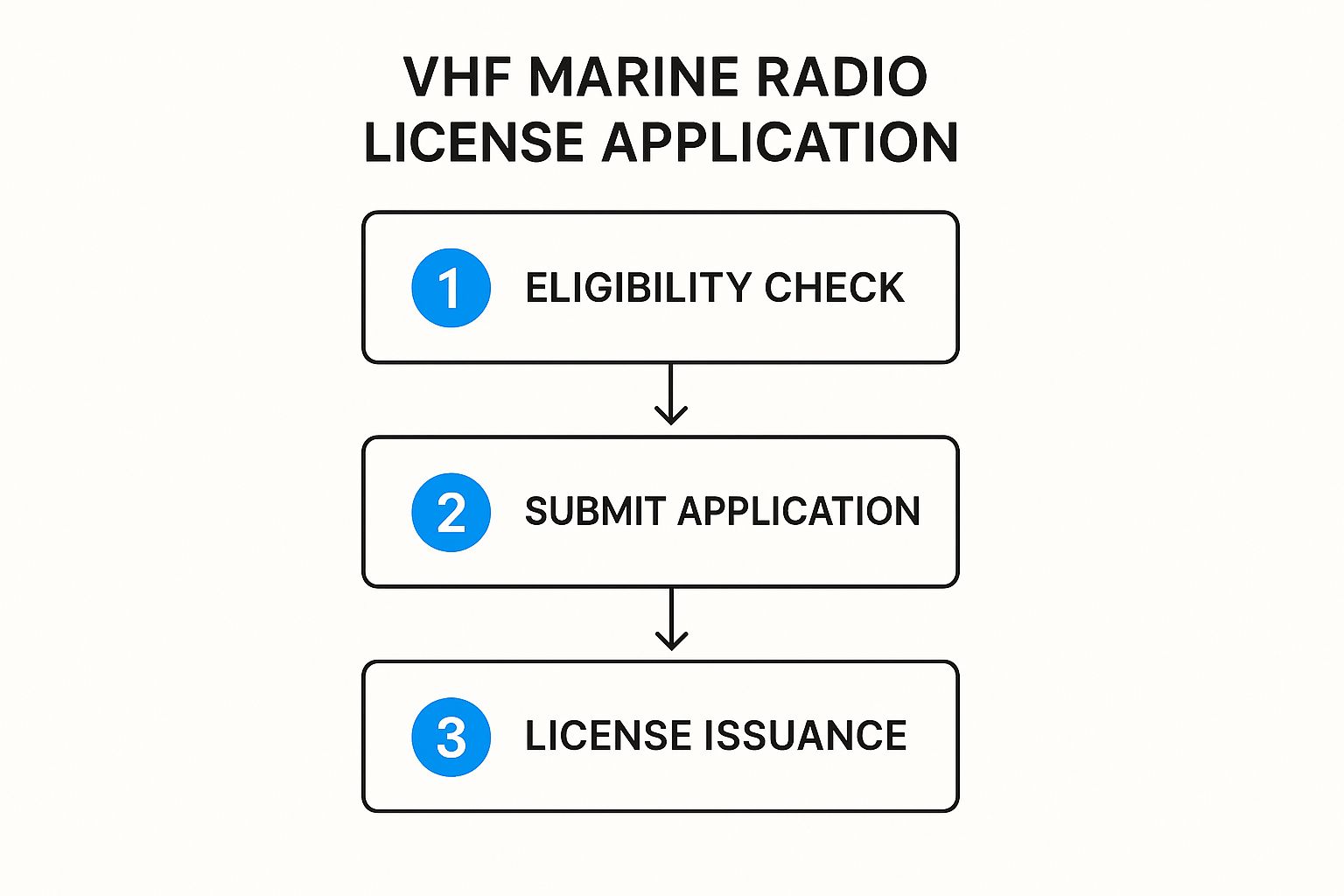
As you can see, once you’ve done the training and passed the assessment, the final application is just a bit of paperwork before the official operator’s licence lands on your doormat.
The Two-Part Mandate for UK Waters
It’s really important to grasp that in the UK, there’s a two-part system for VHF radio. The radio equipment itself needs its own licence (the Ship Radio Licence), and the person operating it needs one too.
For the operator, the SRC is the minimum standard. Getting one involves taking a course and passing the exam, a system designed to ensure anyone transmitting on marine frequencies knows exactly what they’re doing. As you work toward your certificate, you’ll learn everything you need to know about how to use a marine VHF radio effectively.
The combination of flexible online learning and a final, hands-on assessment gives you the best of both worlds. It provides the convenience to study when you want, backed by a practical test that verifies your competence when it truly counts.
Passing your SRC assessment is a genuine milestone for any boater. It means you’re not just certified, but truly prepared for clear, correct, and life-saving communication at sea.
And for those looking to build on their qualifications, you might also find our guide on how to obtain an International Certificate of Competence (ICC) useful for your next steps.
What to Expect in Your SRC Assessment
The final assessment for your VHF marine radio licence can feel like the most intimidating part, but it’s really not. Think of it less as a scary exam and more as a straightforward, practical check to prove you can handle a radio with confidence when it matters.
The whole point of the RYA Short Range Certificate (SRC) assessment is to confirm your skills, not to catch you out. It’s designed to shift your mindset from simply “passing a test” to truly “proving your competence.”
The assessment is split into two distinct parts: a short written paper and a hands-on practical test using real radio simulators. Both are equally important and designed to work together, making sure you have the theory locked in and the real-world skills to back it up at sea.
The Written Examination
First up is a written paper covering the fundamental theory you learned during your RYA course. It’s a multiple-choice format, designed to check your understanding of the core rules and procedures that govern marine radio use. No trick questions here.
You can expect it to cover a few key areas:
- Regulations and Licencing: The basics of why you need a Ship Radio Licence for the boat and an operator’s certificate (the one you’re going for!) for yourself.
- Radio Etiquette: This covers the proper channels for different types of communication, from calling a marina to hailing another vessel without causing chaos on Channel 16.
- The Phonetic Alphabet: You absolutely need to know this by heart. Being able to clearly spell out a vessel name or call sign using Alpha, Bravo, Charlie is non-negotiable for clear communication.
- Emergency Procedures: The paper will test your knowledge of the GMDSS (Global Maritime Distress and Safety System) and the crucial differences between a Mayday, Pan Pan, and Sécurité call.
The Practical Assessment Scenarios
The practical test is where you get to show what you’ve learned. You’ll sit in front of a VHF training radio, and an RYA assessor will ask you to perform a series of common tasks. This isn’t about reciting memorised scripts; it’s about reacting to realistic situations as they unfold.
The goal of the practical assessment is to ensure your skills are second nature. The RYA wants to see that you can operate the radio correctly under pressure, just as you would have to in a real-life situation on the water.
Your assessor will guide you through several scenarios. For instance, you might be asked to make a routine call to a marina to request a berth. Crucially, you will almost certainly be required to demonstrate the correct procedure for sending a digital distress alert using the DSC button and following it up with a full Mayday voice call.
You’ll be assessed on your clarity, your accuracy, and whether you stick to the proper protocols. It’s all about showing you can be a calm, reliable voice on the other end of the radio.
To give you a clearer idea, here are some of the common tasks you can expect to be asked to perform during the practical exam.
SRC Practical Exam Scenarios
| Task | Purpose | Key Skills Demonstrated |
|---|---|---|
| Sending a DSC Distress Alert | To initiate a Mayday alert digitally, notifying all nearby vessels and coastguard stations instantly. | Correct use of the red distress button, inputting the nature of distress. |
| Making a Mayday Voice Call | To follow up the digital alert with a clear voice transmission detailing the emergency. | Adherence to the Mayday script, clear speech, providing essential information (position, nature of distress, number of people). |
| Making a Pan Pan Call | To communicate an urgent situation that is not a life-or-death emergency. | Differentiating between Urgency and Distress, correct channel use, clear communication of the problem. |
| Making a Routine Call | To contact another station (like a marina or another vessel) for non-urgent communication. | Proper hailing procedure, use of working channels, clear and concise language. |
| Receiving a Distress Alert | To demonstrate the correct actions upon hearing a Mayday from another vessel. | Listening without transmitting, logging details, understanding when and how to acknowledge a relay. |
Ultimately, the practical assessment is your chance to put all the theory into practice. It’s the final step in becoming a certified, and more importantly, a competent and confident radio operator.
How to Get Your Ofcom Ship Radio Licence

Once you’ve earned your RYA Short Range Certificate (SRC), you’ve proven you know how to operate a marine radio. The next step is to get the radio equipment itself licenced. This is a simple but vital administrative task done through Ofcom, the UK’s communications regulator.
Think of it this way: your SRC is your driver’s licence, but the Ship Radio Licence is the boat’s registration plate. It officially registers your vessel’s radio gear, assigns it a unique identity, and plugs you into the global maritime safety network.
The whole process is surprisingly painless and can be done entirely online. Here are the actionable steps to get your licence:
- Go to the Ofcom Website: Navigate to the Ofcom online licensing portal.
- Create an Account: Register with your personal details to begin the process.
- Apply for a New Ship Radio Licence: Start a new application and enter your vessel’s details, such as its name, length, and home port.
- List Your Radio Equipment: Specify all maritime radio gear you have on board (e.g., fixed VHF, handheld VHF, EPIRB, SART).
- Submit and Receive Your Licence: Once you submit the application, Ofcom will process it and issue your licence documents, which will include your new Call Sign and MMSI number.
The Importance of Your Call Sign and MMSI
When you apply, Ofcom will issue two critical pieces of information: a Call Sign and a Maritime Mobile Service Identity (MMSI) number.
Your Call Sign (e.g., MABC7) is your boat’s name on the airwaves, used for voice calls. But it’s the nine-digit MMSI that unlocks the most powerful safety features of a modern VHF radio.
Your MMSI is basically your boat’s unique telephone number at sea. You must program this number into your DSC-equipped VHF radio. It’s what allows the big red distress button to send a digital alert, instantly broadcasting who you are and where you are to rescue services and other nearby vessels.
Without an MMSI programmed into your set, the life-saving Digital Selective Calling (DSC) functions of your radio simply will not work. Obtaining your Ship Radio Licence is the only way to get this vital number.
Fees, Renewals, and Management
Here’s some great news for most of us recreational boaters: applying for or renewing a Ship Radio Licence in the UK is now typically free of charge. The licence is valid for a decade and is easily managed through your online Ofcom account.
It’s a simple process that turns a bit of admin into a final, confidence-boosting step, ensuring your vessel is fully compliant and ready for safe communication on the water.
The Evolution of UK Marine Radio Rules
Ever wondered why the VHF marine radio licence system is set up the way it is? The rules you follow today weren’t just dreamed up overnight. They’re the product of decades of real-world experience and refinement, all aimed at making the seas a safer place for everyone.
The regulations have come a long way, evolving from a somewhat fragmented approach into the unified, modern framework we have today. Understanding this journey is key to appreciating why your qualifications are so important. These rules aren’t just arbitrary red tape; they’re a carefully designed system to ensure every radio operator is a reliable link in a global safety network.
The Shift to a Modern Framework
A real turning point came in 2003 with the creation of Ofcom. Before then, radio licensing was managed by the Radiocommunications Agency. This transition marked a huge step forward in modernising the UK’s approach to marine communications.
With Ofcom at the helm, marine VHF licensing became more formalised. This created a much clearer distinction between the licence for the vessel itself and the operator’s certificate of competence. It’s a change that reflects the UK’s commitment to keeping pace with technology and aligning with international safety standards, making sure the system works when it matters most.
Why This History Matters to You
Knowing this background gives real context to your training. It shows that the procedures you learn—especially for distress calls like a Mayday—are part of a life-saving system with a long and proven track record. The strict protocols exist for a very good reason: in an emergency, they ensure communication is clear, efficient, and understood by everyone, everywhere.
By getting your VHF marine radio license, you’re doing more than just ticking a legal box. You’re becoming a competent and trusted part of a proven, life-saving chain. You’re joining a community of mariners who understand their duty to keep the airwaves clear and effective for all.
This principle of standardised rules for safety isn’t unique to radio communications; it’s a cornerstone of good seamanship. You can see the exact same logic at play in the International Rules for the Prevention of Collisions at Sea (IRPCS). Both systems depend on everyone knowing and following the same script to prevent disaster.
Frequently Asked Questions
Even after going through the details, a few specific questions always seem to surface about the UK VHF marine radio licence. Here are some of the most common ones we hear from fellow sailors and boaters, answered in plain English.
Do I Need a Licence for a Handheld VHF Radio?
Yes, absolutely. In the UK, any radio that can transmit on marine VHF frequencies—whether it’s a fixed set or a handheld one—needs two things: a licence for the equipment itself and a certified operator.
For a handheld radio, you’ll need a Ship Portable Radio Licence from Ofcom and your personal RYA Short Range Certificate (SRC). The great thing about the portable licence is that it covers the device, not the boat, so you can legally use it on any vessel you’re on, whether it’s a friend’s yacht, your own dinghy, or a club tender.
Can My Partner or Crew Use the Radio Under My Supervision?
The RYA’s guidance is clear: anyone operating the radio should really have their own certificate. That said, the rules do allow for non-urgent communications to be made under the direct supervision of a qualified operator. And in a genuine emergency, anyone is permitted to use the VHF to call for help.
It’s strongly recommended that all your regular crew get their own SRC. Think about it: in a real emergency, the certified skipper might be the one who’s injured or incapacitated. That’s when it becomes vital for someone else on board to know exactly how to send a distress alert correctly.
How Long Is the VHF Marine Radio Licence Valid For?
This is a two-part answer. Your RYA Short Range Certificate (SRC), which is your personal qualification, is for life. Once you’ve earned it, it never expires.
The Ofcom Ship Radio Licence (for fixed sets) or the Ship Portable Radio Licence (for handhelds) is different. These are typically valid for 10 years. The good news is that for most recreational boaters, renewing them through Ofcom’s online portal is free and straightforward. Just make sure you keep your contact details up to date.
Ready to get certified and become a confident, safe radio operator? At My Sailing Course, we provide a fully animated, RYA-recognised online course to prepare you for your SRC assessment. Learn more and enrol in our SRC (VHF) Marine Radio course today!