

Pass your Day Skipper Theory first time
A confidence chat from AN instructor
If you feel nervous about the Day Skipper assessments, you are in the majority. Most people taking this course have not sat an exam for years. The fear is usually bigger than the work.
Let me reframe it for you. At Day Skipper level there is no fixed pass mark to chase. The goal is to show you understood the concepts taught and can apply them to a question. Your answers are reviewed by an instructor. We look at your method and your reasoning. One small slip early on can produce a wrong final number, but if your working shows you understood the concept and applied it correctly, we can still be confident you have learned what the question was testing.
This is also why we do face-to-face debriefings. It gives you the chance to review mistakes, talk them through, and tighten your process. You do not just get a result. You get constructive feedback, plus a chance to turn a wobble into a clean repeatable method.
How the online assessments work
You complete two online papers. There is a time limit, and the questions only appear once you start. That setup can feel unfamiliar, so the trick is to go in with a simple routine you repeat on every question.
The two papers
Paper 1. General Assessment
This paper checks whether you can look up information and apply it like a skipper. Expect questions across:
Paper 2. Chartwork Paper
This paper focuses on two plotting skills. If you polish these, you will complete the chartwork confidently.
Your mindset: decisions for reasons
There is rarely one perfect answer in navigation. We want decisions for reasons. If you can show the method you chose and why you chose it, you are doing the job of a skipper. That is the real standard behind the Day Skipper level.
How to beat assessment anxiety
The biggest hurdle is not the content. It is the moment you click start and your brain tries to sprint. Use this routine instead.
If we have done our job correctly, you will be prepared. You will have seen the types of tasks you are being asked to demonstrate. You will also know that an early slip does not erase understanding if your method is clear and your working is visible.
What to revise, and why
General Assessment: the high value topics
1) Almanac lookups
Practise finding information quickly and reading the small notes. In many questions, the marks live in those notes. When you answer, include the page title or section name you used. It proves your source and keeps your thinking tidy.
2) Weather in two lines
Get used to writing a short brief for the passage window. Wind range, likely direction change, sea state, and visibility. Then add one decision with a reason. This is the skipper skill the paper is trying to draw out.

Weather Forecast Capture Sheet
3) Buoyage and basic buoy lights
These are quick marks if you revise little and often. Aim to identify the mark, state what it means, then state the safe water and direction of travel. If the question adds a light, keep it basic. Colour, rhythm, and what it tells you.
Use our buoyage flashcards for revision.
4) Tides: the port choice rule that catches people out
This is the mistake I see most often because it feels like the same task. It is not. You must choose the correct port for the job you are doing.
When you are working out tidal height (how deep it is or whether you will clear a drying patch), use the tidal information for the nearest standard port to your location or the exercise area. That gives the best height prediction for where you are.
When you are working out tidal streams (set and rate for chart plotting), use the reference port stated at the top of the tidal stream atlas page or at the top of the tidal diamond table. In the training exercises this is often Victoria. The reminder is printed at the top of the page. Look up before you start.
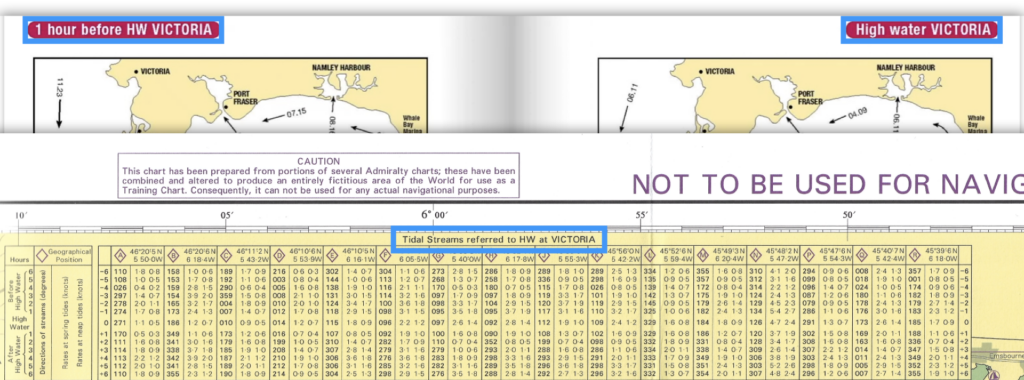
Memory rule: Heights use the nearest port. Streams use the port named on the atlas or diamond page.
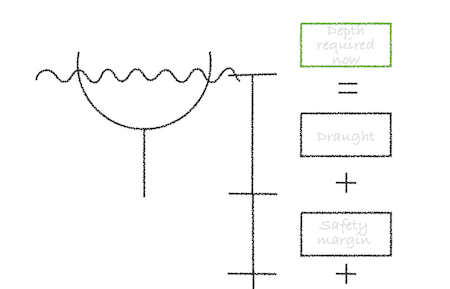
Height of tide needed to clear a charted depth
Height of tide needed to clear a drying height
5) COLREGs and basic vessel lights
Keep it simple. Focus on safe speed, lookout, collision risk, and the basics of what lights mean. You are not trying to memorise every edge case. You are showing you can interpret the situation and act safely.
Day Skipper - Day Shapes, Lights & Sounds
Chartwork Paper: polish two skills
1) Estimated Position
EP is about method and clarity. Plot a DR, apply set and drift when required, label the time, and do a quick sense check against the charted picture. If your EP ends up in a ridiculous place, the fix is usually one earlier step, not the whole method.
How to plot an Estimated Position
How to plot Dead Reckoning
2) Course to Steer
CTS is a repeatable process. Correct time window, tidy vectors, clear labels, and one final check. Practise until the setup feels automatic. Once it is, the whole paper becomes calmer.
How to plot a Course to Steer
Your final week plan
Why the debrief matters
The debrief is where learning locks in. It lets you talk through any slips and show your understanding. It also lets the instructor give targeted feedback so you leave with a clean method you can reuse on the water. That is the goal. Safe, repeatable decisions for reasons.
Downloads used in this guide
How to plot an Estimated Position
How to plot a Course to Steer
Height of tide needed to clear a charted depth
Height of tide needed to clear a drying height
Weather Forecast Capture Sheet