

The Story Behind Sailors’ Tattoos: A Tradition Written in Ink
Walk into almost any marina and you’ll spot someone with an anchor on their arm, a swallow on their shoulder or a compass rose on their calf. Today, nautical tattoos are popular with sailors and non-sailors alike, but many of these designs have a fascinating history that stretches back hundreds of years.
Long before tattoos became mainstream, they were part of life at sea. For many sailors, they weren’t simply decoration. They told a story, marked achievements, offered protection and, in some cases, helped identify a sailor if they were lost at sea.
Where Did the Tradition Begin?
People have been tattooing themselves for thousands of years, but maritime tattoo culture as we know it today really flourished during the great voyages of exploration in the eighteenth century.
When Captain James Cook and his crews sailed through the Pacific between 1768 and 1779, they encountered the heavily tattooed Polynesian peoples of Tahiti and New Zealand. Cook’s journals introduced the word tattoo into the English language, derived from the Polynesian word tatau, meaning “to mark”. Many members of his crew returned home with tattoos of their own, helping spread the practice throughout Britain and Europe.
Although European sailors had been tattooing themselves before Cook’s voyages, these expeditions firmly established tattoos as part of maritime culture. By the end of the eighteenth century, tattoos were common among Royal Navy sailors, merchant seamen and whalers.
More Than Decoration
Life at sea was dangerous. Voyages could last for months, storms could appear without warning and many sailors never returned home.
For sailors, tattoos became a permanent record of their lives and achievements. Unlike today, where photographs and social media capture our adventures, a sailor’s skin became a personal logbook. Every design had meaning.
Some tattoos celebrated a milestone, while others were believed to bring good fortune or protect against the dangers of the sea. Sailors were famously superstitious, and many genuinely believed certain symbols would improve their chances of surviving a storm or shipwreck.
The Meaning Behind Famous Sailor Tattoos
⚓ The Anchor
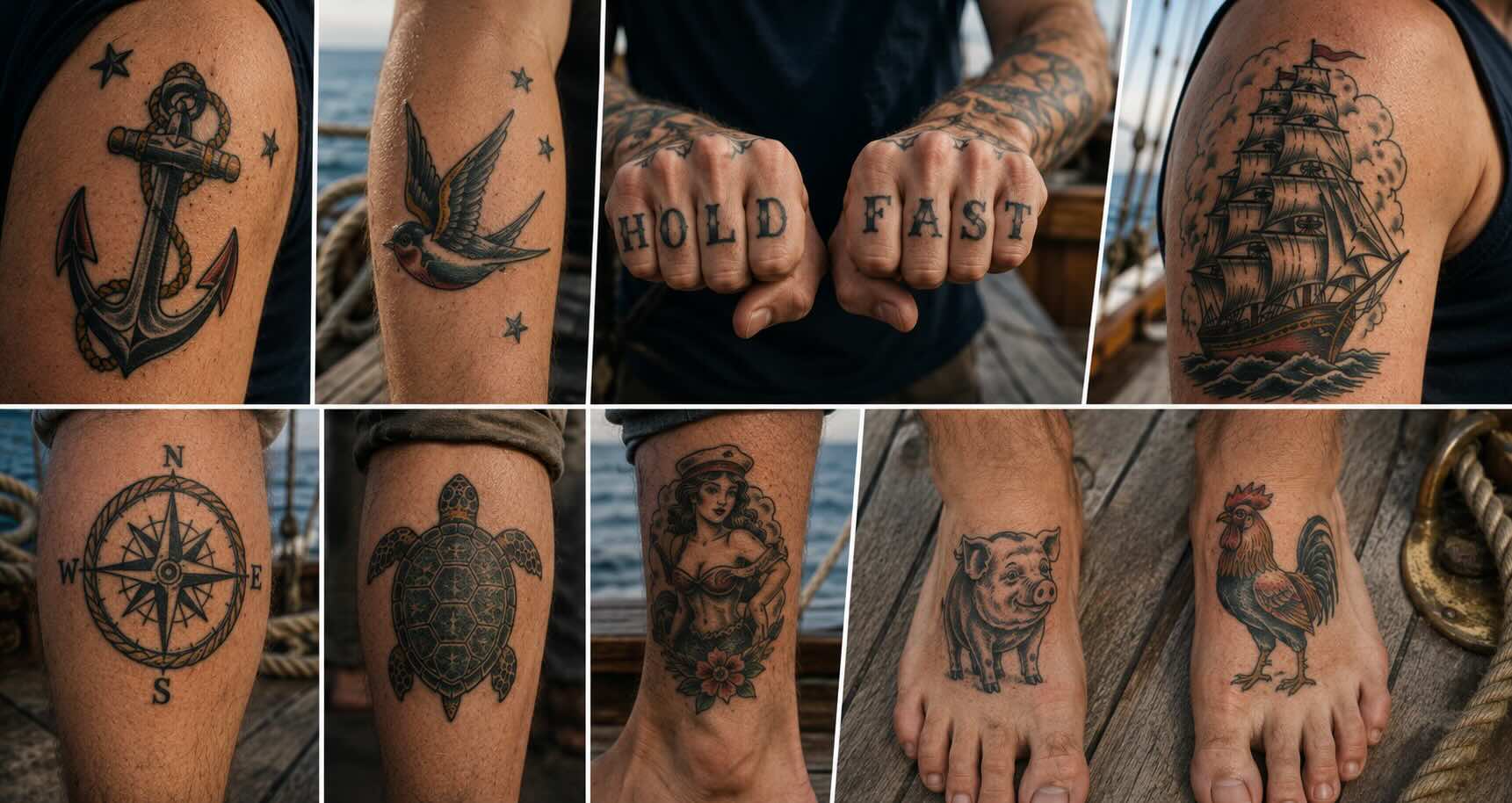
Perhaps the best-known nautical tattoo, the anchor symbolised stability, hope and experience.
Traditionally, an anchor tattoo often marked a sailor who had crossed the Atlantic Ocean. It also represented someone who had found their footing after spending long periods at sea. Even today, it remains one of the most recognisable symbols of a life connected to the water.
🐦 The Swallow
The swallow is one of the oldest and most respected sailor tattoos.
Because swallows always return to the same nesting grounds after migration, they became a symbol of returning safely home. Tradition suggested a sailor earned one swallow after sailing 5,000 nautical miles, with a second swallow awarded after another 5,000 miles.
Some sailors also believed that, if they drowned, a swallow would carry their soul to heaven.
🐖🐓 Pig and Rooster
At first glance, these seem like strange animals for a sailor to choose.
The story comes from the days of wooden sailing ships, when pigs and roosters were transported in floating wooden crates. If a ship sank, these crates often floated free, giving the animals a chance of survival.
Many sailors tattooed a pig on one foot and a rooster on the other, believing the symbols would help them survive a shipwreck and make it safely back to land.
🐢 Shellback Turtle
Crossing the Equator has long been a significant milestone for sailors.
Those completing the famous “Crossing the Line” ceremony often celebrated with a turtle tattoo, becoming known as a “Shellback”. Even today, many navies continue this centuries-old tradition when sailors cross the Equator for the first time.
⛵ Full-Rigged Ship
A tattoo of a full-rigged sailing ship wasn’t chosen simply because it looked impressive.
Traditionally, it showed that a sailor had successfully rounded Cape Horn, one of the most feared passages in the world. Before the Panama Canal opened, every voyage around Cape Horn tested both crew and vessel against huge seas, freezing temperatures and relentless storms.
A full-rigged ship tattoo showed the wearer had earned serious respect.
✋ HOLD FAST
Many sailors had the word “HOLD” tattooed across the knuckles of one hand and “FAST” across the other.
The belief was straightforward. If those words were permanently on your hands, perhaps you’d hold on tightly to the rigging when the weather became rough.
Whether it improved anyone’s grip is debatable, but it became one of the most iconic sailor tattoos ever created.
🧭 Compass Rose
Although more common in modern times, the compass rose has become a favourite among sailors.
It represents guidance, safe navigation and always finding your way home. For many modern yachtsmen and women, it symbolises a love of navigation and adventure rather than a specific achievement.
Tattoos Could Save Lives… Or Identify Them
Tattoos weren’t always about tradition or superstition. They also served a practical purpose.
Before passports, driving licences and DNA records, tattoos helped identify sailors who died at sea or in foreign ports. Naval records frequently included detailed descriptions of tattoos alongside a sailor’s height, eye colour and any distinctive scars.
In an age before modern identification, those markings could provide families with long-awaited answers.
From the Dockyard to Mainstream Culture
As sailors returned from distant voyages, tattooing gradually spread beyond the ports.
By the late nineteenth century, professional tattoo artists had established studios in many British and American dockyards. The invention of the electric tattoo machine made the process quicker and more affordable, allowing tattooing to become increasingly popular among the general public.
Today, tattoos are found across every walk of life, but many of the most popular designs still have their roots firmly planted in maritime history.
The Tradition Lives On
Modern sailors don’t usually earn tattoos by rounding Cape Horn or surviving months at sea, but the tradition is far from over.
Many choose an anchor after buying their first boat. Others commemorate an ocean crossing with the latitude and longitude of a memorable landfall, a compass rose or even the outline of their yacht.
The meanings may have evolved, but the purpose remains remarkably similar. Tattoos still tell stories. They celebrate achievements, remind us of adventures and preserve memories that might otherwise fade with time.
Next time you spot a swallow, an anchor or the words “Hold Fast” on someone’s arm, remember that you’re looking at more than artwork. You’re seeing part of a tradition that has connected sailors across the world’s oceans for more than 250 years.
Whether you’re studying for your Day Skipper Theory course or planning your first offshore passage, it’s a reminder that sailing isn’t just about charts, tides and weather. It’s also about the people, traditions and stories that have shaped life at sea for generations.