Press Gangs
Groups authorised by naval authorities to forcibly recruit men into naval service, often through coercion or outright abduction.
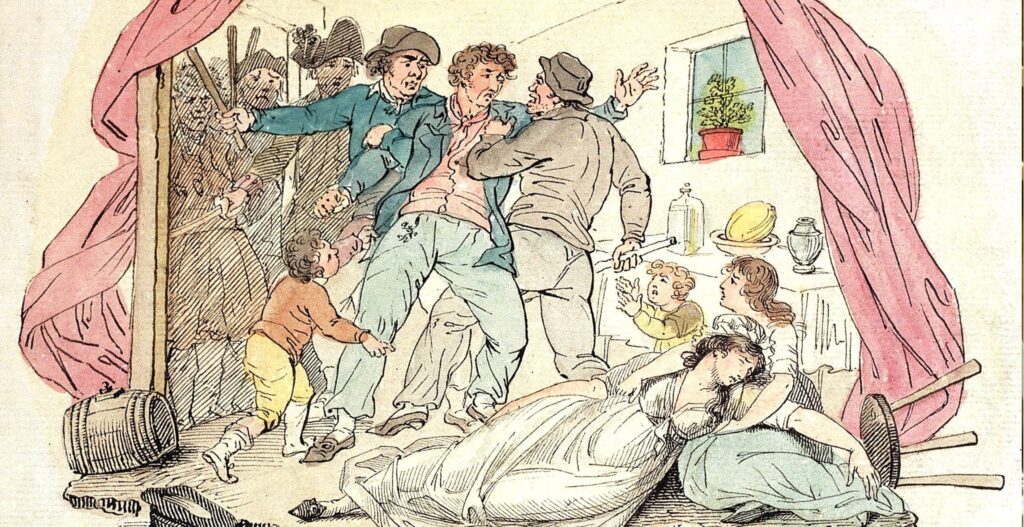
Press gangs were not subtle. They did not send polite invitations, nor did they wait for volunteers. If you were a reasonably fit man near a British port in the 17th to early 19th centuries, you were, at least in theory, a potential recruit for the Royal Navy whether you agreed or not.

The practice was known as impressment. The navy needed crews, often in large numbers and at short notice, especially during wartime. Rather than rely solely on willing sailors, authorised groups called press gangs were sent ashore to find them. “Find” is doing a lot of work here. In reality, they would round up men from docks, taverns, and occasionally straight off the street, then escort them back to a waiting ship. Resistance was common. Success was also common.
The word “press” comes from the idea of being pressed into service. It was not a suggestion. Once taken, a man could find himself at sea within hours, learning the ropes in the most literal sense. Some were experienced seafarers. Others had never set foot on a vessel before. The navy was not overly concerned about that detail.
Press gangs operated under legal authority, though that did little to make them popular. They were often led by naval officers and supported by local officials, and they carried warrants that allowed them to detain men deemed suitable for service. There were limits, at least on paper. Certain trades and professions were exempt, and impressment was technically restricted to seafaring men. In practice, those lines could blur after a long night near the docks.
Life on board was not easy, which is why voluntary recruitment was not always reliable. Conditions were harsh, discipline was strict, and the work was demanding. For some, impressment led to a long naval career and even advancement. For others, it was simply a rough introduction to life at sea with no real choice in the matter.
Over time, the practice became controversial. It strained relations with local communities and even contributed to tensions with other countries, particularly when foreign sailors were caught up in the process. By the early 19th century, as recruitment methods improved and public attitudes shifted, impressment began to fade. Eventually, it was abandoned altogether.
The phrase “pressed into service” has outlived the practice itself. Today, it has lost most of its menace. You are far more likely to hear it used when someone is reluctantly asked to help with something. A neighbour might be pressed into service to move a sofa. A colleague might be pressed into service to cover a last-minute meeting. The stakes are considerably lower, and the chances of being taken away to sea without warning are, reassuringly, close to zero.
That shift in meaning is part of what makes the phrase interesting. It carries a hint of its past, a suggestion of reluctance or lack of choice, but it is now used lightly, often with a bit of humour. It turns an inconvenience into a story rather than a crisis.
Press gangs themselves have become part of maritime folklore. They appear in films, novels, and sea stories, usually depicted as slightly menacing figures who arrive at exactly the wrong moment. While the reality was often harsher than the stories suggest, they remain a vivid reminder of a time when naval power depended not just on ships and guns, but on finding enough people to sail them.