
Glossary Archive
Compass
A navigational instrument that determines direction relative to the Earth’s magnetic poles. It typically consists of a magnetised needle aligning with the Earth’s magnetic field, indicating north, south, east, and west. Compasses are essential tools for navigation at sea and on land.
Compass Add East for True
The CADET mnemonic can help remember the corrections needed when converting between True North and Compass North bearings. It assists in adjusting for magnetic variation and deviation, which is essential for accurate navigation. Here’s what each letter in CADET represents: CADET Mnemonic Breakdown C — Compass: Start with the compass bearing, the direction the compass...
Compass Rose
A circular diagram on nautical charts and compasses that displays directions relative to true north and magnetic north, often including information about magnetic variation. A compass rose is a navigational tool printed on nautical charts and instruments, showing the orientation of cardinal directions—north, east, south, and west—as well as intermediate points. It typically consists of...
Competent Crew
The RYA Competent Crew course introduces beginners to life on board a sailing yacht. Over five days, participants learn essential skills such as steering, ropework, sail handling, and basic safety procedures. The course emphasizes teamwork and confidence-building, making it ideal for those new to sailing. By the end, participants will feel capable of contributing effectively...
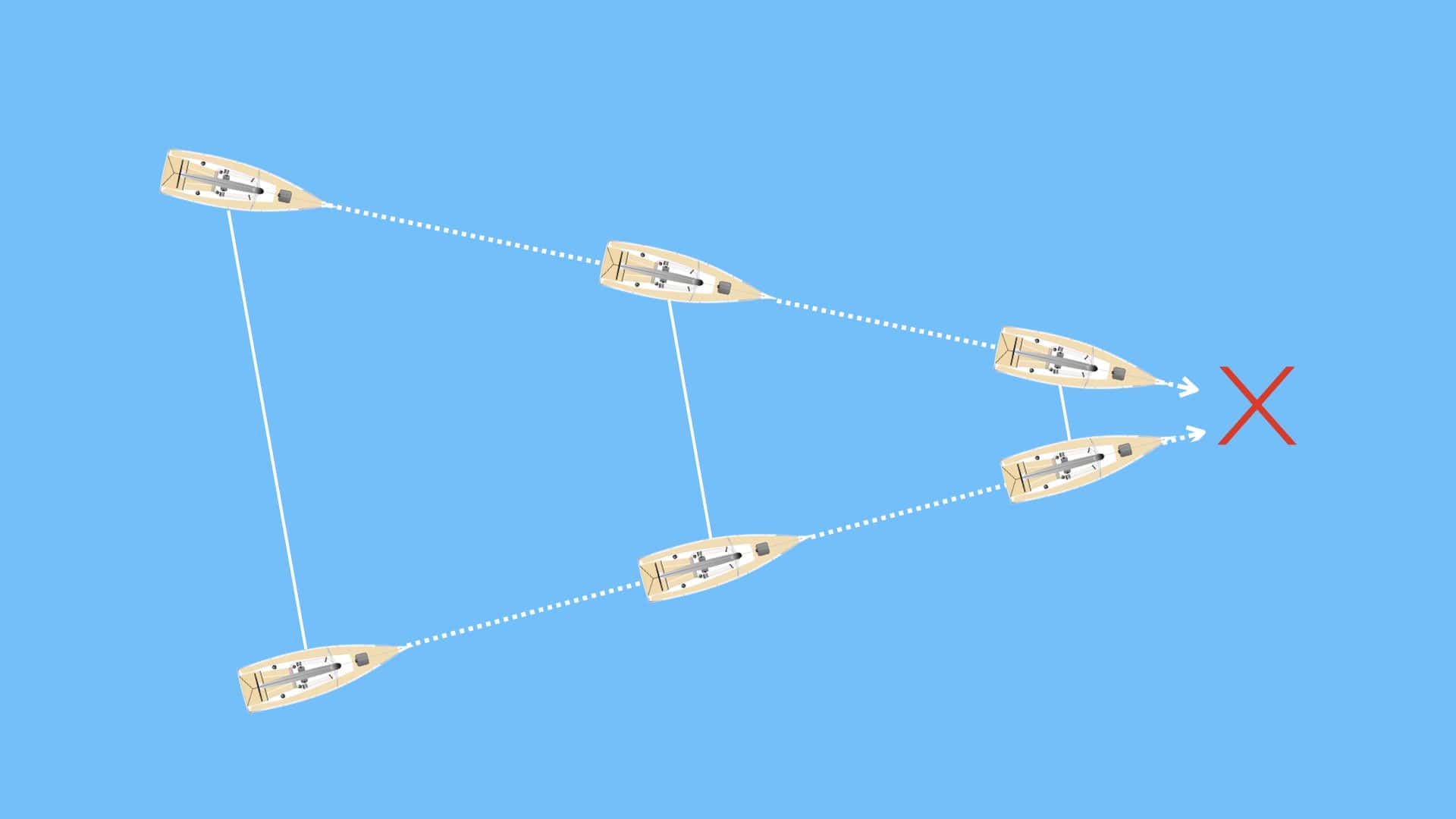
Constant Bearing, Decreasing Range
A navigational situation where two vessels maintain the same relative bearing to each other while the distance between them diminishes, often indicating a potential risk of collision. Constant bearing, decreasing range (CBDR) is a concept in maritime navigation, used to assess collision risks between vessels at sea. When two vessels are on a CBDR trajectory,...
Constrained by Draught
A vessel whose ability to deviate from its current course is significantly restricted due to the depth of water relative to its draught. A vessel "Constrained by Draught" refers to a specific situation under the International Regulations for Preventing Collisions at Sea (COLREGs), where a ship's manoeuvrability is severely limited because of the relationship between...
Contour Line
A line on a nautical chart that connects points of equal depth below the water's surface, representing the underwater topography. A contour line, also known as a depth contour or isobath, is a critical feature on nautical charts used by mariners to interpret the underwater landscape of a body of water. These lines are drawn...
Coordinated Universal Time
The primary time standard by which the world regulates clocks and time serving as the basis for civil time globally. Coordinated Universal Time (UTC) is the internationally recognised time standard that ensures uniformity in timekeeping across the globe. It is not a time zone but rather a reference point from which all time zones are...
Coriolis Effect
The apparent deflection of moving fluids, such as air or water, caused by the Earth's rotation, influencing large-scale ocean currents and wind patterns. The Coriolis Effect arises due to the rotation of the Earth and affects the movement of fluids across its surface. As the Earth spins, different latitudes move at different linear velocities —...
Cospas-Sarsat System
An international satellite-based search and rescue system that detects and locates distress signals from emergency beacons to assist in maritime, aviation, and land-based rescues. The Cospas-Sarsat System is a global satellite network designed to provide accurate and timely distress alert and location data to assist search and rescue (SAR) operations. It operates using a combination...